

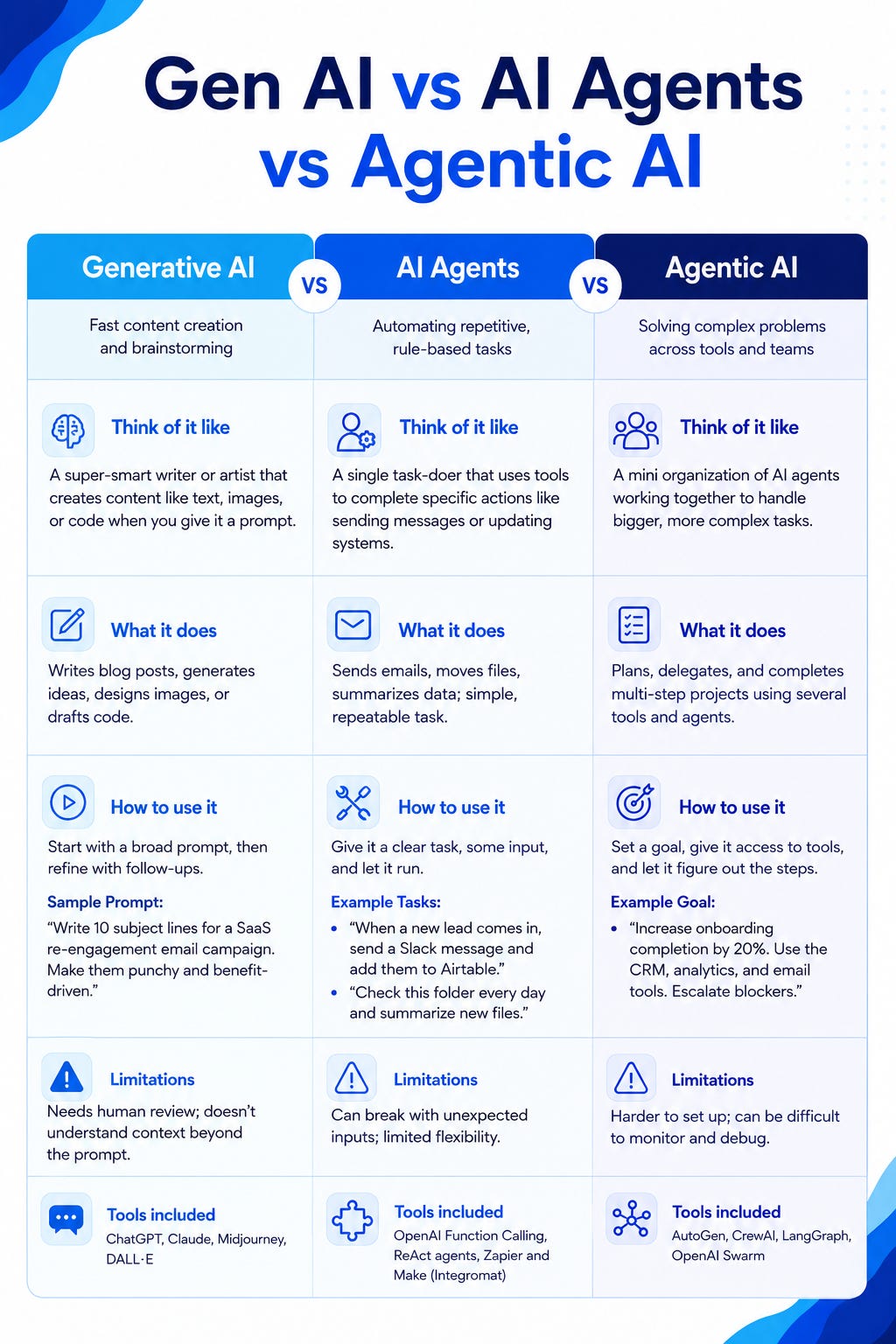
Everyone is using these three terms. Almost nobody is using them correctly.
You will hear “Gen AI,” “AI Agents,” and “Agentic AI” in the same meeting, sometimes by the same person, often meaning different things each time. This post draws a clean line between them - not with academic definitions, but with the kind of clarity that helps you actually build things.
Start here: what problem is AI solving?
Before defining the terms, it helps to understand what question each one is answering.
Gen AI answers: “Can a machine generate content that looks and feels human-made?”
AI Agents answer: “Can a machine take actions in the world, not just produce outputs?”
Agentic AI answers: “Can a machine pursue a goal across multiple steps, making its own decisions along the way?”
These are three genuinely different questions. The technologies that answer them share foundations but are structurally distinct.
1. Generative AI - the content engine
What it is
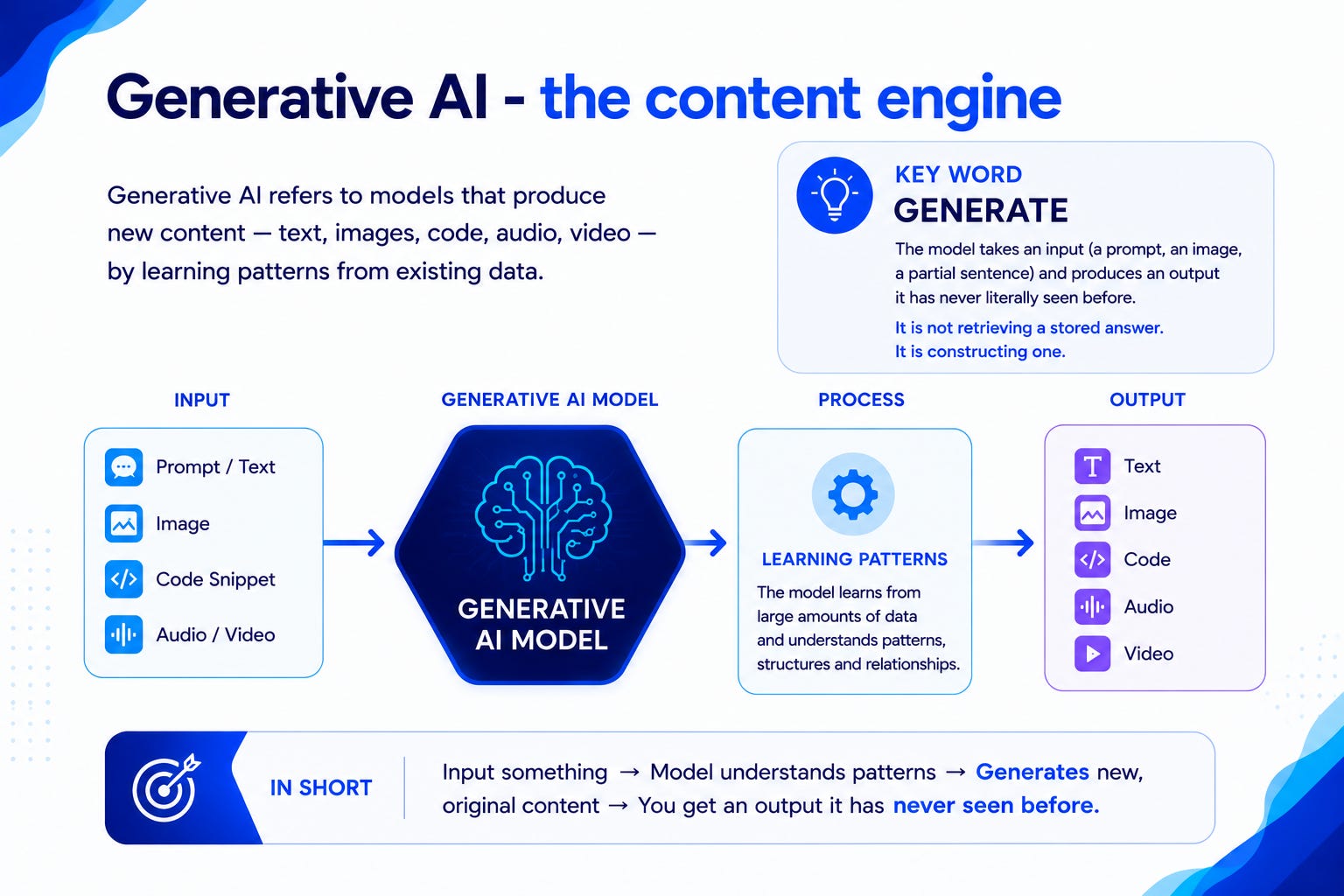
Generative AI refers to models that produce new content - text, images, code, audio, video - by learning patterns from existing data.
The key word is generate. The model takes an input (a prompt, an image, a partial sentence) and produces an output it has never literally seen before. It is not retrieving a stored answer. It is constructing one.
Real-life example
Think of a photocopier vs a painter.
A photocopier reproduces exactly what you put in front of it. It retrieves. A painter, given a brief - “paint a monsoon street in old Mumbai” - creates something new from everything they have ever learned, seen, and absorbed. No two painters produce the same painting from the same brief.
Gen AI is the painter. It has learned from millions of examples and can now produce something new every time - an explanation, an image, a piece of code - that did not exist before you asked for it.
A more everyday example: every time you ask ChatGPT to explain recursion, it writes a new explanation. It is not pulling a stored answer from a database. It is generating a fresh one, each time, shaped by your exact prompt.
What it looks like in practice
You ask ChatGPT to summarise a research paper. It writes a summary.
You ask Midjourney for a logo concept. It generates one.
You ask GitHub Copilot to complete a function. It writes the code.
In each case: input in, output out. The model generates and stops. It does not remember what you asked yesterday. It does not check whether its answer was correct. It does not take any further action.
The important limit
Gen AI is stateless and passive. It speaks, but it cannot act. It advises, but it cannot execute. It writes the email - but it cannot send it.
In a nutshell
Generative AI takes a prompt and produces content. It is a one-shot transaction - input in, output out. Extraordinarily capable, but fundamentally passive. It talks. It does not do.
2. AI Agents - the action takers
What it is
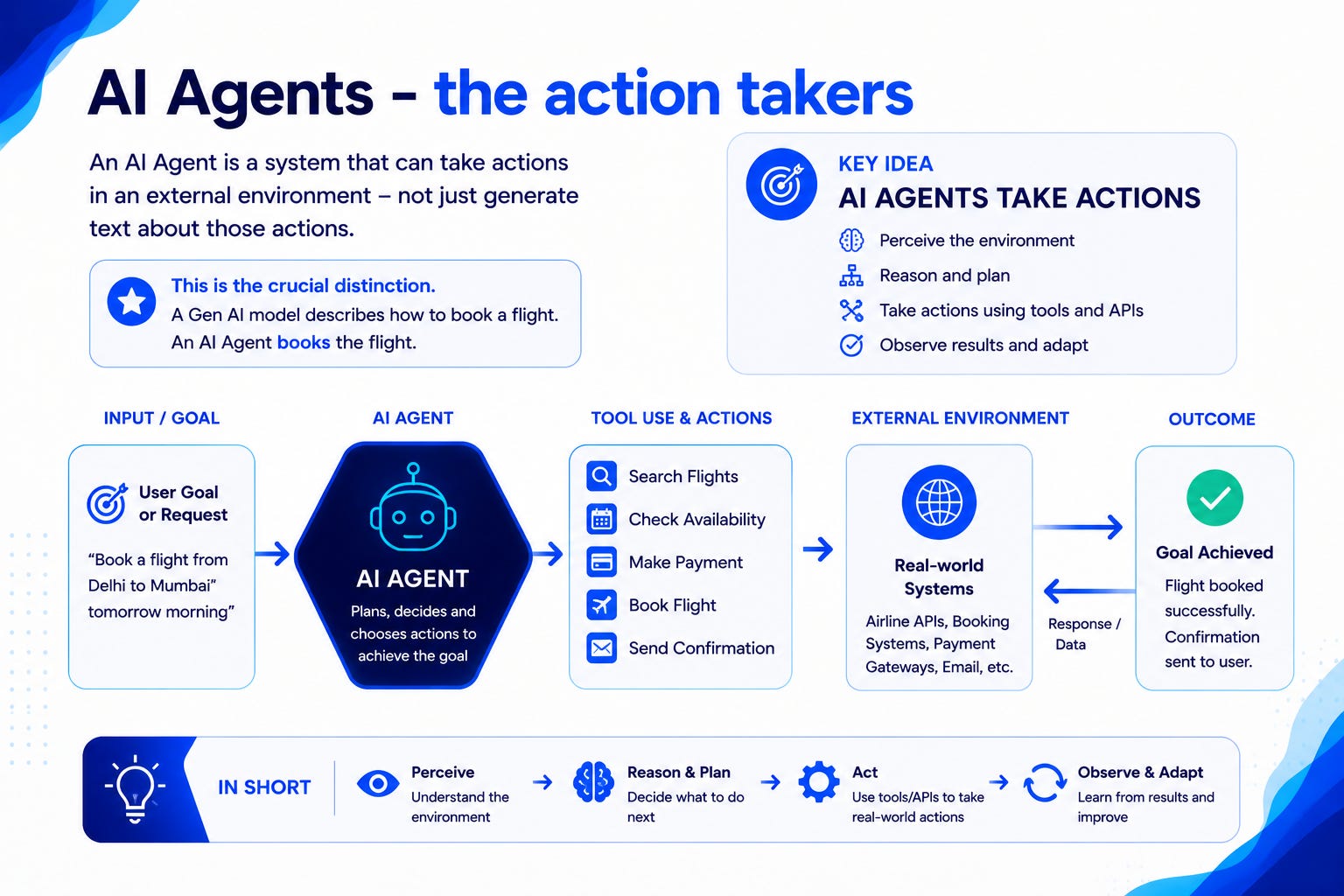
An AI Agent is a system that can take actions in an external environment - not just generate text about those actions.
This is the crucial distinction. A Gen AI model describes how to book a flight. An AI Agent books the flight.
Real-life example
Think of the difference between a travel advisor and a travel agent.
You walk into a travel advisory office and ask for help planning a trip to Rajasthan. The advisor gives you a beautiful plan - best time to visit, which cities, what hotels, what route. That is Gen AI. It generates the perfect plan. You leave the office with information.
Now imagine a full-service travel agent. You give them the same brief. They pick up the phone, call the airline, book the tickets, reserve the hotel, arrange the cab, email you the confirmation, and call you the morning of departure to remind you. They acted. They did things in the world. That is an AI Agent.
The travel agent has everything the advisor has - knowledge, reasoning, communication skills - plus the ability to do something with it.
What makes something an agent
Four things separate an agent from a plain Gen AI model:
Perception - it can observe the environment (read a webpage, check an inbox, query a database, see a screenshot)
Reasoning - it decides what to do next based on what it observes
Action - it does something in the world (sends an email, executes code, calls an API, fills a form)
Feedback loop - it sees the result of its action and adjusts accordingly
What it looks like in practice
A customer support agent that reads a complaint email → checks the order database → identifies the issue → sends a resolution, without a human touching it
A research agent that takes a query → searches the web → reads relevant pages → returns a synthesised answer with sources
A coding agent that takes a bug report → reads the relevant code → writes a fix → runs the tests → submits a pull request
The important limit
Most AI Agents today handle one task at a time. Give them a task and they complete it. The task has a start and an end. They are not running in the background managing a portfolio of goals. That is where Agentic AI begins.
In a nutshell
An AI Agent is Gen AI with hands. It does not just produce content - it takes actions, observes results, and adjusts. The difference is not in intelligence. It is in whether the system can reach out and do something in the world.
3. Agentic AI - the goal pursuer
What it is
Agentic AI is what happens when you take AI Agents further - giving them not just the ability to act, but the ability to plan and act across multiple steps toward a longer-horizon goal, with minimal human intervention along the way.
The difference between an AI Agent and Agentic AI is not a binary - it is a spectrum of autonomy. But conceptually:
An AI Agent handles a task: “Book me a flight to Mumbai on Friday.”
Agentic AI handles a goal: “Plan my travel to Mumbai for the conference next week - flights, hotel, and prep my presentation from these notes.”
To accomplish the second, the system needs to decompose the goal, sequence the tasks, execute each one, handle failures mid-way, maintain context throughout, and only surface to ask for human input when genuinely necessary.
Real-life example
Think of the difference between a contractor and a project manager.
You hire a contractor to lay tiles in your kitchen. You tell them exactly what to do. They do it. That is an AI Agent - capable, reliable, action-taking, but operating within a defined, single task.
Now think of a project manager overseeing your entire home renovation. You give them the goal - “I want this house ready to move into by September.” They break it down: which contractor comes first, what permits are needed, what happens if the electrician is delayed, how to resequence when the tiles arrive late. They make dozens of decisions without asking you each time. They manage the full arc from goal to outcome.
That is Agentic AI - it holds the goal, manages the plan, takes the actions, and handles the unexpected.
A real-world software example: Devin (an AI software engineering agent) can take a GitHub issue and autonomously navigate the codebase, understand what is broken, write a fix, run the tests, debug failures from the test output, revise the fix, and submit a pull request - all without a human stepping in between each step.
What it looks like in practice
AI research pipelines that take a question, find papers, read them, synthesise findings, and draft a literature review
AI systems that manage a sales outreach workflow - find prospects, research them, draft personalised emails, follow up based on response, and escalate to a human only when there is a warm lead
AI product managers (experimental) that monitor user feedback, identify themes, draft feature specs, and flag them for human review - running continuously in the background
The important limit
Agentic AI introduces new failure modes that do not exist in simpler systems. A Gen AI model can hallucinate. An AI Agent can take a wrong action. Agentic AI can pursue a goal in the wrong direction for many steps before anyone notices - compounding errors across a long chain. This is why human-in-the-loop checkpoints, sandboxed execution environments, and robust rollback mechanisms are critical in agentic systems.
In a nutshell
Agentic AI is an AI Agent with a project manager built in. It does not just take actions - it plans which actions to take, in what order, and what to do when things go sideways. You give it a goal. It figures out the rest.
The clearest way to see the difference - one scenario, three versions
Scenario: “I need to research competitors for my startup.”
Gen AI response: Writes you a comprehensive framework for competitive analysis. Lists the dimensions you should research, the tools you could use, and what to look for. Excellent content. You now have to go and do all of it yourself.
AI Agent response: Takes the competitor names you provide → searches the web for each one → reads their websites, pricing pages, and recent news → returns a structured comparison document with sources. You had to tell it exactly what to research. It did the research.
Agentic AI response: You describe your startup. It identifies who your competitors probably are → researches each one → monitors their product updates over the next two weeks → alerts you when one of them launches a new feature or changes pricing → drafts a “competitive positioning” section for your pitch deck based on everything it found. You gave it a goal. It managed the whole process.
Why the confusion exists - and why it matters
These three things share the same foundation - LLMs - and are often built on top of each other. Most AI Agents use a Gen AI model as their reasoning core. Most Agentic AI systems are multi-agent pipelines where each individual agent is itself Gen AI-powered.
This layering creates the illusion that the terms are interchangeable. They are not. The distinction is in structure and scope of autonomy, not the underlying model.
A useful test when you hear any claim about “AI”:
Does it generate, or does it act?
Does it do one thing, or does it plan a sequence of things?
Does it wait for you at each step, or does it run until it is done?
The answers tell you exactly which of the three you are dealing with - and whether the claim being made is credible.
Putting it all together
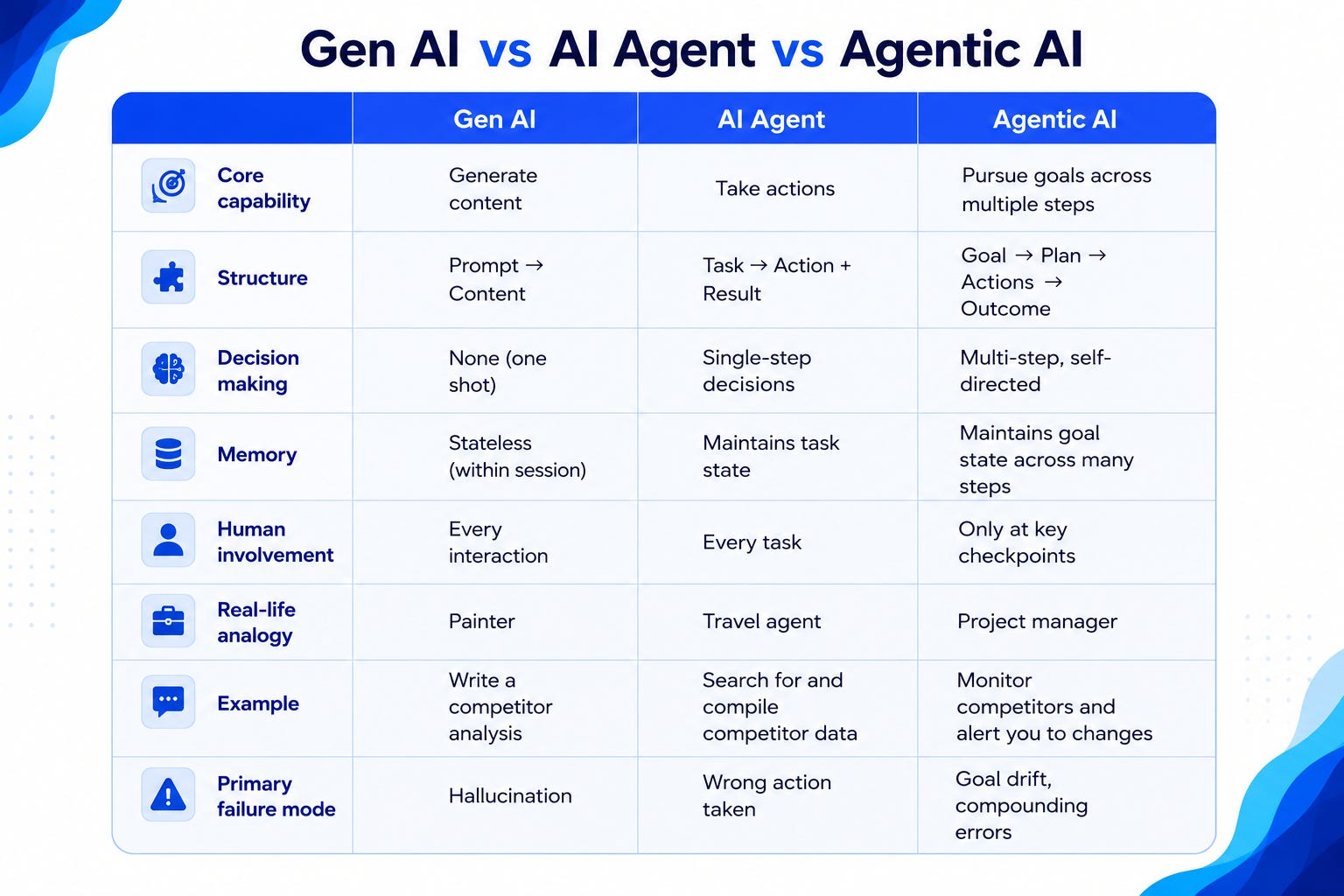
Why this matters for engineers building today
Understanding this distinction changes how you design AI systems.
Gen AI is your reasoning and content layer - the intelligence core you call when you need language understanding, synthesis, or generation.
AI Agents are how you connect that intelligence to the real world. Add tool calling, API access, and a feedback loop to a Gen AI model and you have an agent.
Agentic AI is what you build when one action is not enough - when the problem requires a plan, a sequence, and the ability to recover from failure without asking for help at every step.
Most production AI products today are in the transition from Gen AI to AI Agents. The frontier - and where the most valuable engineering problems currently live - is Agentic AI.
If you are learning to build AI systems, learning these three layers in order is not just conceptually useful. It is the actual architecture of how modern AI products are built.
Alta School of Technology is India’s first AI-first, project-based B.Tech in Computer Science. Every concept in this series is something our students build with - not just study.